Words of my uncle:
For adults, gambling was the most popular pastime. Men played mah-jong, dominoes, and poker. Women played mainly poker. No big money was involved. Gambling produced a very important side benefit - education in arithmetic. Players were compelled to learn Arabic numerals, addition, subtraction, multiplication, division and fractions. That proved to be very useful in the mid-1930's, when paper money gradually replaced the silver coin as common currency.
For kids, we played all sorts of games. On the ground, we made our own toys, games and balls. We used a piece of rock as the nucleus, then wrapped around it with waste papers and tied it with strings. That was a ball, any size. We used it as volleyball, baseball, etc. where bouncing was not required. Any rope tied between two trees could be used as volleyball net. Any stick could be used as baseball bat. Any flat surface could be used as ping pong table. Jump-rope was also popular. Any game that cost no money would be popular.
For the air, we made our own kites: butterfly, eagle, snake, caterpillar, etc. We also invented some sort of musical instrument attached to the kite. It was a very thin and fine piece of bamboo-bark string, stretched tightly on a bow, which was then attached to the top of the kite. When the kite flew high up in the sky, the wind blew on the string and produced a smooth beautiful sound, almost like a trumpet. When the kite danced up and down, that sound also waved up and down in tempo and scale. With a little imagination, that was like an orchestra.
For the water, we had very little water sports except swimming for boys. After a heavy rain when the nearby streams were swollen, we made tiny wooden sailing boats, less than one foot long, for racing.
For the whole family, monthly festivals were important events, which will be described in another chapter.
*****
In conclusion, country life in China was harsh and slow paced. It was also peaceful and harmonious. People of all ages had to work hard for a living. Men did most of the hard work. Women did most of the domestic work. Kids pitched in wherever capable. Elderly did the babysitting and lighter chores. People lived off the land. There was very little industry, service or jobs. People also were attached to the land. There was very little traveling or moving. The country life was remarkably stagnant and conservative; it remained essentially unchanged generation after generation.
Showing posts with label Chapter 3. Show all posts
Showing posts with label Chapter 3. Show all posts
Friday, June 5, 2015

Wednesday, June 3, 2015
Country Life (1924-1936) - Water Front
Words of my uncle:
Waterfront was not a beautiful sandy beach for swimming, boating or skiing, although our district was only ten miles from the Pacific Ocean. Waterfront simply means the river, ponds, swamps, brooks, canals and ditches for fishing. Fishing was not for fun or sport, either. It was for food and livelihood. The catch was an important source of protein and income.
In our district, flooding occurred almost every year, and high tide often brought salty ocean water to our Front Door River. Therefore, wherever there was a puddle of water, we found fish there.
Clam was abundant along some sandy banks of the river. Snail was plentiful in the rice field. Catfish was found along the shores of river or swamp. Crab was about an inch long, found along any bank or ditches. Mudskipper was found along the muddy part of the river bank, together with eels. In the deeper water, there were bass, mackerel, shrimp and many other species. We even caught turtle occasionally, hard shell or soft shell.
We caught fish by three methods: with bare hands, with a net, or with poison herbs. Poison herbs were only very occasionally used, at certain seasons, and at a limited scale. The poison herb would either deprive the fish of needed oxygen, or made them dizzy, so they would float to the surface upside down to be easily caught. By hand was the most common way. A fish, when spotted, was usually caught with two hands, approaching from behind, because fish have monocular vision with broad lateral visual field. The hand below was to prevent the fish from thrusting forward by instinct. The hand above was to immobilize the fish by surprise. There was a certain trick - the middle and index finger were to catch its head, the thumb and ring finger were spreading out to catch its body just behind its pectoral fins. Otherwise its pectoral fins might stab and hurt you, especially catfish. In deeper water, we first built a mud dam to wall off the area, then drew the water out either with a water wagon and hand paddle. Then we caught the fish in shallow water. Such a project could be an individual one, or done by a group of 10 to 20 men.

We had two kinds of fish nets: small one with a short stick that any little kid could handle, and big one called "tang" that only an adult could handle. The "tang" has a stick about ten feet long, the man had to straddle over it for better control. It was supported by four bamboo sticks, one at each corner, each about four feet long. It was quite heavy. When folded, the whole thing was like a folded umbrella.
Once a fish was caught, it was put into a fish basket, hung over the shoulder. The cover of the basket was like a trap, a fish could get in, but not out, so the whole basket was soaked in the water from time to time in order to keep the fish alive and fresh. They were all made of bamboo, of course. A fish basket and a small fish net were standard tools for almost every single household in our district, even the poorest family could own one, for they could be handmade. We happened to own a big net, too, handed down from our grandfather.
Mother hardly did any fishing. Brother did very little because he was the man of the house and stayed home most of the time babysitting or housekeeping. I was the one that did most of the fishing, mostly for fun but sometimes I earned a meal of delicacy - seafood. I was once bitten by a snake, non-poisonous.
Clam and snail could be "picked", not caught. They were usually cooked with garlic and salted black bean, delicious. My maternal grandmother used the clam shell for another purpose: mouse trap. She placed some clam shell at the bottom of a deep water bucket, with some food-bait on top of the shell. At night, when the mice got down to the bucket, they also stepped on the clam shell that caused a noise. Grandma then quickly covered the bucket and trapped them. Mudskipper is the one and only fish that could also walk on mud. It is about the size of a finger. When deep fried, it was delicious, even the fish bone. We had two kinds of eels - yellow and white. Yellow eel was smaller but much more delicious. White eel was larger and more meaty. Eel is very slimy and must be firmly hooked between the dorsal surface of index-ring fingers, and ventral surface of middle finger, proximal phalanx.
Professional fishermen used much larger nets. They lived on boats and made their catch from larger rivers or the ocean.
Waterfront was not a beautiful sandy beach for swimming, boating or skiing, although our district was only ten miles from the Pacific Ocean. Waterfront simply means the river, ponds, swamps, brooks, canals and ditches for fishing. Fishing was not for fun or sport, either. It was for food and livelihood. The catch was an important source of protein and income.
In our district, flooding occurred almost every year, and high tide often brought salty ocean water to our Front Door River. Therefore, wherever there was a puddle of water, we found fish there.
Clam was abundant along some sandy banks of the river. Snail was plentiful in the rice field. Catfish was found along the shores of river or swamp. Crab was about an inch long, found along any bank or ditches. Mudskipper was found along the muddy part of the river bank, together with eels. In the deeper water, there were bass, mackerel, shrimp and many other species. We even caught turtle occasionally, hard shell or soft shell.
We caught fish by three methods: with bare hands, with a net, or with poison herbs. Poison herbs were only very occasionally used, at certain seasons, and at a limited scale. The poison herb would either deprive the fish of needed oxygen, or made them dizzy, so they would float to the surface upside down to be easily caught. By hand was the most common way. A fish, when spotted, was usually caught with two hands, approaching from behind, because fish have monocular vision with broad lateral visual field. The hand below was to prevent the fish from thrusting forward by instinct. The hand above was to immobilize the fish by surprise. There was a certain trick - the middle and index finger were to catch its head, the thumb and ring finger were spreading out to catch its body just behind its pectoral fins. Otherwise its pectoral fins might stab and hurt you, especially catfish. In deeper water, we first built a mud dam to wall off the area, then drew the water out either with a water wagon and hand paddle. Then we caught the fish in shallow water. Such a project could be an individual one, or done by a group of 10 to 20 men.

We had two kinds of fish nets: small one with a short stick that any little kid could handle, and big one called "tang" that only an adult could handle. The "tang" has a stick about ten feet long, the man had to straddle over it for better control. It was supported by four bamboo sticks, one at each corner, each about four feet long. It was quite heavy. When folded, the whole thing was like a folded umbrella.
Once a fish was caught, it was put into a fish basket, hung over the shoulder. The cover of the basket was like a trap, a fish could get in, but not out, so the whole basket was soaked in the water from time to time in order to keep the fish alive and fresh. They were all made of bamboo, of course. A fish basket and a small fish net were standard tools for almost every single household in our district, even the poorest family could own one, for they could be handmade. We happened to own a big net, too, handed down from our grandfather.
Mother hardly did any fishing. Brother did very little because he was the man of the house and stayed home most of the time babysitting or housekeeping. I was the one that did most of the fishing, mostly for fun but sometimes I earned a meal of delicacy - seafood. I was once bitten by a snake, non-poisonous.
Clam and snail could be "picked", not caught. They were usually cooked with garlic and salted black bean, delicious. My maternal grandmother used the clam shell for another purpose: mouse trap. She placed some clam shell at the bottom of a deep water bucket, with some food-bait on top of the shell. At night, when the mice got down to the bucket, they also stepped on the clam shell that caused a noise. Grandma then quickly covered the bucket and trapped them. Mudskipper is the one and only fish that could also walk on mud. It is about the size of a finger. When deep fried, it was delicious, even the fish bone. We had two kinds of eels - yellow and white. Yellow eel was smaller but much more delicious. White eel was larger and more meaty. Eel is very slimy and must be firmly hooked between the dorsal surface of index-ring fingers, and ventral surface of middle finger, proximal phalanx.
Professional fishermen used much larger nets. They lived on boats and made their catch from larger rivers or the ocean.
Country Life (1924-1936) - Vegetable Garden
Words of my uncle:
In Chinese literature, vegetable garden and rice field were often tied together, so called "The pleasure of field and garden." Another famous verse: "Weeds are taking over the field and garden, why don't you come home?" Literature is the product of the intellectuals, the upper class. For the majority of poor peasants living in the countryside, field and garden are hard work.
We owned two strips of vegetable garden in an ancestral vacant lot. When my sister was still an infant, mother carried her on her back and brought top soil to fill up the strips. One strip was about 3 x 20 feet. Top soil was built up to about six inches high. From those narrow land plots, mother raised quite a variety of vegetables. The trick was good planning and good rotation, plus timely irrigation and fertilization. It was all hard work. Mother did most of it. Garden vegetables needed water almost every day. If no rain fell, we had to bring in water.
Throughout the years, we had the following items to supplement our diet: bok toy, guy toy, Chinese broccoli, string beans, winter melon, Chinese pumpkin, silk melon, eggplant, bitter melon, green onion, garlic, taro, ginger. Sweet potato, peanut, and gut-ling potato were raised far away, halfway up the hill on sandy soil where they required less water. Tomato, corn and potato were not popular. We had no green pepper. All peppers were hot, regardless of color red or green. Cabbage and cabbage fruit were also very common. Spinach was uncommon. Hung toy was grown in the swamp, plentiful, almost wild, and cheap. We had no (European) radish, but we had white radish, shaped and grown like carrot, but white inside and outside, and bigger than sweet potato, plentiful and cheap (known as daikon). Carrot was very uncommon. We had no cucumber, no squash.
Mother did most of the garden work. Brother did most of the baby-sitting and home-watching. Once the produce was brought home, kids helped out, especially my brother who had a remarkable capacity to endure a very long night without sleep ever since he was 6 or 7 years old.
We had no electricity or refrigeration in the country. Food storage depended on past experience and innovation. Peanut was grown underground and entangled in roots and vines. Each single peanut had to be sorted out and cleaned. Then the peanut was handled in several ways: sun-dried with or without shell; roasted with or without shell; boiled and then sun-dried with or without shell. The shell was recycled as fuel and the ash as fertilizer. Peanut was an important source of fat and protein. Sweet potato must be peeled, sliced, cooked (boiled) and then sun-dried before ready for storage. Otherwise the budding would shoot out and the potato became rotten. The peeled skin was used as hog feed. Bok toy could be sun-dried. Buy toy could be salted, partially sun-dried, then shut into a jar to ferment and become "salty and sour vegetable."
There was a medical story about the fermented vegetable. It occurred in the north, in a county by the Yellow River. In the 1960's, according to the Tumor Registry, the Beijing Communist Government discovered a striking concentration of carcinoma of the esophagus in one single county, among thousands of counties throughout China. This particular form of cancer not only occurred in humans, but also in hogs and chickens. The barefoot doctors and researchers found a common denominator in all these three species was the diet - they all ate the products of one kind of fermented vegetable, which contains a carcinogen, and the formation of that carcinogen was due to lack of molybdenum (a rare metal element) and a certain vitamin in the soil if that county. The soil deficiency was properly treated and the epidemic was cured. They also applied the Pap Smear principle to detect early cases - barefoot doctors penetrated into every household of the village, had the elderly swallow a thread with a brush at the end, and brush the esophageal wall for cytology study. Such study picked up many early cases for curative surgery.
In the American surgical journal "Annal of Surgery" (the yellow journal in contrast to the Blue SGO), a 1977 or 1978 issue, the surgical treatment of esophageal carcinoma in China was reported by Dr. Yingkai Wu, a thoracic surgeon graduated from Peiping Union Medical College (PUMC) and trained at Barne Hospital of Washington University in St. Louis in the late 1930's. He reported about 800 cases, with an 80-plus percent cure rate. He happened to be the younger brother of our professor and chief of medicine Dr. C.C. Wu. When we were interned at St. Louis University from 1950-1951, every thoracic surgeon in St. Louis asked us if we knew Dr. Y. K. Wu.
Gut-ling potato was a kind of carbohydrate. It must be ground with water. The colloid was sun-dried to become flour and the residue was used as hog feed. The flour when cooked was like tapioca. Taro was also a kind of carbohydrate and could be stored as such for months. Both sweet potato and taro were eaten widely as alternatives to supplement the inadequacy of rice.
In Chinese literature, vegetable garden and rice field were often tied together, so called "The pleasure of field and garden." Another famous verse: "Weeds are taking over the field and garden, why don't you come home?" Literature is the product of the intellectuals, the upper class. For the majority of poor peasants living in the countryside, field and garden are hard work.
We owned two strips of vegetable garden in an ancestral vacant lot. When my sister was still an infant, mother carried her on her back and brought top soil to fill up the strips. One strip was about 3 x 20 feet. Top soil was built up to about six inches high. From those narrow land plots, mother raised quite a variety of vegetables. The trick was good planning and good rotation, plus timely irrigation and fertilization. It was all hard work. Mother did most of it. Garden vegetables needed water almost every day. If no rain fell, we had to bring in water.
Throughout the years, we had the following items to supplement our diet: bok toy, guy toy, Chinese broccoli, string beans, winter melon, Chinese pumpkin, silk melon, eggplant, bitter melon, green onion, garlic, taro, ginger. Sweet potato, peanut, and gut-ling potato were raised far away, halfway up the hill on sandy soil where they required less water. Tomato, corn and potato were not popular. We had no green pepper. All peppers were hot, regardless of color red or green. Cabbage and cabbage fruit were also very common. Spinach was uncommon. Hung toy was grown in the swamp, plentiful, almost wild, and cheap. We had no (European) radish, but we had white radish, shaped and grown like carrot, but white inside and outside, and bigger than sweet potato, plentiful and cheap (known as daikon). Carrot was very uncommon. We had no cucumber, no squash.
Mother did most of the garden work. Brother did most of the baby-sitting and home-watching. Once the produce was brought home, kids helped out, especially my brother who had a remarkable capacity to endure a very long night without sleep ever since he was 6 or 7 years old.
We had no electricity or refrigeration in the country. Food storage depended on past experience and innovation. Peanut was grown underground and entangled in roots and vines. Each single peanut had to be sorted out and cleaned. Then the peanut was handled in several ways: sun-dried with or without shell; roasted with or without shell; boiled and then sun-dried with or without shell. The shell was recycled as fuel and the ash as fertilizer. Peanut was an important source of fat and protein. Sweet potato must be peeled, sliced, cooked (boiled) and then sun-dried before ready for storage. Otherwise the budding would shoot out and the potato became rotten. The peeled skin was used as hog feed. Bok toy could be sun-dried. Buy toy could be salted, partially sun-dried, then shut into a jar to ferment and become "salty and sour vegetable."
There was a medical story about the fermented vegetable. It occurred in the north, in a county by the Yellow River. In the 1960's, according to the Tumor Registry, the Beijing Communist Government discovered a striking concentration of carcinoma of the esophagus in one single county, among thousands of counties throughout China. This particular form of cancer not only occurred in humans, but also in hogs and chickens. The barefoot doctors and researchers found a common denominator in all these three species was the diet - they all ate the products of one kind of fermented vegetable, which contains a carcinogen, and the formation of that carcinogen was due to lack of molybdenum (a rare metal element) and a certain vitamin in the soil if that county. The soil deficiency was properly treated and the epidemic was cured. They also applied the Pap Smear principle to detect early cases - barefoot doctors penetrated into every household of the village, had the elderly swallow a thread with a brush at the end, and brush the esophageal wall for cytology study. Such study picked up many early cases for curative surgery.
In the American surgical journal "Annal of Surgery" (the yellow journal in contrast to the Blue SGO), a 1977 or 1978 issue, the surgical treatment of esophageal carcinoma in China was reported by Dr. Yingkai Wu, a thoracic surgeon graduated from Peiping Union Medical College (PUMC) and trained at Barne Hospital of Washington University in St. Louis in the late 1930's. He reported about 800 cases, with an 80-plus percent cure rate. He happened to be the younger brother of our professor and chief of medicine Dr. C.C. Wu. When we were interned at St. Louis University from 1950-1951, every thoracic surgeon in St. Louis asked us if we knew Dr. Y. K. Wu.
Gut-ling potato was a kind of carbohydrate. It must be ground with water. The colloid was sun-dried to become flour and the residue was used as hog feed. The flour when cooked was like tapioca. Taro was also a kind of carbohydrate and could be stored as such for months. Both sweet potato and taro were eaten widely as alternatives to supplement the inadequacy of rice.
Country Life (1924-1936) - The Mountains
Words of my uncle:
The mountain is a unique feature in our district. A gigantic range of rolling hills and mountains was within walking distance from our area. About 4 or 5 generations before my time, it was said that a grandma was carried away by a tiger from her own doorstep. When I was a kid, I heard that a pig barn in the marketplace was raided by wild animals at night and the remains of a large hog were found nearby the next morning. Some sighted in the dark an animal similar to a big dog. One fresh grave was dug up and the corpse was partly eaten. I suspect it could be hyena or wolf.
One abundant resource in the mountain was firewood. The most abundant firewood in our region was fern. It provided a very important source of income for people from miles around. It was far better than any gold mine, iron ore, or any other metallic mine. In mining, the whole ecology would be forever disrupted. For harvesting firewood, nature would replenish it year after year.
Every morning before daybreak, when men-folk were heading for the rice field, most women-folk were heading for the mountain. They walked in staggering groups, talking, laughing, and gossiping all the way. Each of them was equipped with a bamboo stick for shoulder-carrying, a sickle for cutting the fern, and a bunch of hay-ropes for tying up the bundles. Going to the rice field, where it was wet and muddy , people went barefoot. Going to the mountain, where it was dry and rocky and sometimes thorny, people wore leather sandals which were cut from ox hide.
At the mountain, each individual could place some markings there to claim a small territory. she then bent down and cut as much fern as she could, and laid it there to let sun-dry. The dried up fern left from the day before was then tied into two large bundles, one placed on each end of the bamboo stick, and carried home. Again the whole group jogged home together, and rested on the way together. By early afternoon, most women were home to cook supper.
Two bundles of fern weigh from 50 to 100 lbs., depending on one's own capacity. It could be sold in the market and traded for 1 to 2 lbs. of rice, enough for a meal. Mom did some mountain works. We kids didn't.
While the women-folk were halfway up the mountain, the oxen were grazing down at the foothill where grass was abundant, under the watchful eyes of shepherd boys. Each boy could handle 1 to 2 oxen. Those boys invented lots of songs and stories which were an important part of Chinese folklores.
Besides firewood, the mountain also produced wild fruits. One kind during the hot summer season was call nam. It was somewhat like blackberry, except the skin was thick and smooth. It was delicious but invariably caused constipation.
It was during one of those mountain trips that my cousin-aunt rescued the life of a Communist cadet. That cadet was under hot pursuit by the Nationalist troop. She hid him under piles of cut fern, and later brought him home under the cover of darkness. When the Communists finally won, that cadet became the chief executive of Taishan County and my cousin-aunt became a celebrity.
The mountain is a unique feature in our district. A gigantic range of rolling hills and mountains was within walking distance from our area. About 4 or 5 generations before my time, it was said that a grandma was carried away by a tiger from her own doorstep. When I was a kid, I heard that a pig barn in the marketplace was raided by wild animals at night and the remains of a large hog were found nearby the next morning. Some sighted in the dark an animal similar to a big dog. One fresh grave was dug up and the corpse was partly eaten. I suspect it could be hyena or wolf.
One abundant resource in the mountain was firewood. The most abundant firewood in our region was fern. It provided a very important source of income for people from miles around. It was far better than any gold mine, iron ore, or any other metallic mine. In mining, the whole ecology would be forever disrupted. For harvesting firewood, nature would replenish it year after year.
Every morning before daybreak, when men-folk were heading for the rice field, most women-folk were heading for the mountain. They walked in staggering groups, talking, laughing, and gossiping all the way. Each of them was equipped with a bamboo stick for shoulder-carrying, a sickle for cutting the fern, and a bunch of hay-ropes for tying up the bundles. Going to the rice field, where it was wet and muddy , people went barefoot. Going to the mountain, where it was dry and rocky and sometimes thorny, people wore leather sandals which were cut from ox hide.
At the mountain, each individual could place some markings there to claim a small territory. she then bent down and cut as much fern as she could, and laid it there to let sun-dry. The dried up fern left from the day before was then tied into two large bundles, one placed on each end of the bamboo stick, and carried home. Again the whole group jogged home together, and rested on the way together. By early afternoon, most women were home to cook supper.
Two bundles of fern weigh from 50 to 100 lbs., depending on one's own capacity. It could be sold in the market and traded for 1 to 2 lbs. of rice, enough for a meal. Mom did some mountain works. We kids didn't.
While the women-folk were halfway up the mountain, the oxen were grazing down at the foothill where grass was abundant, under the watchful eyes of shepherd boys. Each boy could handle 1 to 2 oxen. Those boys invented lots of songs and stories which were an important part of Chinese folklores.
Besides firewood, the mountain also produced wild fruits. One kind during the hot summer season was call nam. It was somewhat like blackberry, except the skin was thick and smooth. It was delicious but invariably caused constipation.
It was during one of those mountain trips that my cousin-aunt rescued the life of a Communist cadet. That cadet was under hot pursuit by the Nationalist troop. She hid him under piles of cut fern, and later brought him home under the cover of darkness. When the Communists finally won, that cadet became the chief executive of Taishan County and my cousin-aunt became a celebrity.
Wednesday, May 20, 2015
Country Life (1924-1936) - The Rice Field
Words of my uncle:
I was a country boy, born in the country and raised up in the country. Amazingly, country life changed very little throughout the past hundreds of years. It was harsh. People had to work very hard all year long and could barely make a living. They worked mainly on four areas: rice field, mountain, vegetable garden, and waterfront.
Rice Field
Rice is the main crop in the southern half of China. People spent most of their time in the rice field. Seeding began in early February. The rice grain chosen for seeds was soaked in water daily for budding. The budding seeds were then scattered by hand onto a prepared corner of the rice paddy. In about thirty days, the seeds would grow into green fluffy young rice plants called "yiang". The yiang was then shaved off as sod. The sod was planted into the prepared rice field by hand, in small bundles, one by one, in orderly rows, about one foot apart. Planting was a back-breaking job.


 To prepare the rice field, the soil was first tilled over with an ox-powered plow. This was the heaviest job among all farm works. Water was then brought in to flood the field. Water irrigation was so essential in agriculture that it demands all the ingenuity and tedious hard work. Next the tilled and flooded soil was broken loose with an ox-powered rake. Finally all exposed hay stumps and weeds were stepped down by bare feet, to bury them deep into the mud. The field was thus ready for planting.
After planting, again water is vital. Proper water level must be maintained at all times. In heavy rain, the peasants had to patrol the rice field in order to make sure that the yiang was not being drowned by over-flooding, day and night, facing the storm, hurricane or any weather. In dry weather, water must be brought in from the river, ponds or swamps, through the small canals, ditches, or high banks. Then de-weed. Then fertilizer. In about 120 days, the yiang would grow into tall and golden matured rice stalk call "wo", drooping down with heavily laden rice grain. It was ready for harvest. Water was then drained out to let the grain dry.


In harvest, each bundle was cut with a sickle about 6 inches above ground. The grain was then threshed off from the stalks either on the field or at home. On the field, the stalks were threshed against a huge wooden drum. At home (carried home on shoulder), the stalks were threshed against a large smooth-surfaced rock called "wo rock". The empty stalks now become hay. The rice grain must be sun-dried within the next few days, otherwise it would bud and become rotten. The grain was then ready for storage, market or consumption.

For consumption, the lighter grain shell was first ground off by a grain grinder, then blown away from the much heavier rice by a wind-chest or the natural wind. Next the light brown rice membrane was polished off by a rice polisher. The end product, snowy white rice, was then ready for storage, market or cooking. The freshly harvested rice was most delicious.
Hay was utilized to braid ropes, sandals, to feed oxen, or as bedding material for human, ox, pig, or as cooking fuel. Grain shell was utilized as insulator or cooking fuel. Rice membrane was used to feed ox, pig, chicken or human. All ash was utilized as fertilizer. The recycling process was thorough in China. All materials were in such short supply that we Chinese never could afford to waste anything.
All farm work was done in bare feet and with bare hands. Those who could not afford an ox had to plow the rice field with a garden hoe, by hand, one chop at a time, and had to rake the soil with a hand rake, by hand, one piece of soil at a time. That was the way Chinese farmed their land over 3,000 years before the plow was invented and the oxen were harnessed. The plow and oxen revolutionized agriculture, tremendously increasing land productivity and placing Chinese civilization on top of the world.
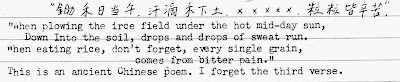
We owned about three quarters of an acre rice paddy, inherited from great grandfather. In my father's time, my grandmother was a widow and did not farm. After my father left home for America, and all three of us kids grew up a little, mother farmed that land for several years. We hired someone to do the plowing and the raking. Mother did most of the rest. My brother and I helped out in some minor chores. Stomping down the hay stumps into the mud was one of our favorites, in spite of the threat of leeches. Operating the "water wagon" was another chore that we could help mom with. To push the revolving wheel, mom pushed one handle, one of us pushed the other. On the field, kids could do very little else. At home, kids could do more. We helped to sun dry the grain an hay, grain grinding, rice polishing, braiding ropes, picking up manure (with bamboo basket and long bamboo fork).
My brother in particular worked hard. He had a remarkable enduring power to stay up late without sleep. He was the "man of the house," helping mom on almost every house chore, including babysitting my sister and caring for all the domestic animals. That was one reason that he never did have free time to learn swimming as well as I did. At meal time, we never had a dull moment. Mom and my brother always discussed this and that. We were taught the sense of responsibility and decency early in our life. When my brother left home for boarding school, that responsibility fell on me. When I left home for school, it fell on my sister. All three of us were fortunate and smart enough to become an intellectual, and yet not ashamed to do manual labor. We learned cooking, laundry, house cleaning, carrying water from the river, gardening, etc. before we were 10 years old.
Among the farm tools, the most fascinating one was the "water wagon." Ever since I was a little kid, it caught my curiosity. When I was helping mom, I kept watching and analyzing how it worked. I soon "discovered" its mechanism was quite simple. It was nothing but a long wooden cylinder, divided into an upper tunnel and a lower tunnel. Inside the tunnel, an "army" of rectangular boards revolved downward in the upper tunnel, and upward in the lower tunnel. When the little boards returned in the lower tunnel, it caught the water in between two boards, and brought it all the way to the upper end, and emptied it. The trick was the two turning wheels, one at each end, that kept the little boards revolving. Another trick was the hinge joints connecting the boards. The joints could be straightened, and could be bent.
 Another fascinating tool was the grain grinder. When I was helping mom, I wondered how it worked. Why the grain kept on coming out and not staying in? Then one time I had the opportunity watching the whole grinder being built from scratch. The trick was the arrangement of the bamboo teeth. They were arranged in a certain angle, so when the upper teeth of the grinder revolved clockwise, all the grain was pushed outward; counter-clockwise, it regurgitated back upward.

The trick of constructing a wooden water bucket was also on the "angle." Many pieces of wooden boards, 2 inches wide and 2 feet long, were cut at a certain slightly slanting angle along each side. When the "sides" were put together, it therefore formed a circular cylinder. They were put together with bamboo nails, both ends of which were sharp and pointy. An old Chinese proverb said: "There was no nail in the world that could have both ends sharp." That means you cannot have things both ways. When there is advantage, there is always some disadvantages. A needle has one sharp end. The other end got to be blunt. But those bamboo nails for water bucket were an exception.
The rice polisher was a permanent fixture in every single household. It remains the same size, same shape and at the same site. It was operated by feet. When the shorter end was forcibly stepped upon, the upper end jumped up, then fell back down into the rice. Each move created a rhythmic sound. When I was helping mom or doing it together with my brother, such rhythmic music amused me. An adult could tilt it alone. Kids like my brother and I were not strong enough to do that. In wealthy families, such work was done by slaves. During the Han Dynasty, the first emperor Liu Bang had many concubines. He particularly favored a young one call Chi (Qi). His empress Looi (Lu) was jealous. At Liu Bang's death, Empress Looi took control of the dynasty and took revenge against concubine Chi. Chi was punished to polish rice, day and night, as a slave. At the time, Chi had a young son, who became a king and was exiled far away to a frontier state. Hearing that rhythmic music, Chi composed and sang a song:

"Son becomes king. Mother becomes slave. Polishing rice all day long. When sun sets, my only companion is death. Oh, who is the messenger to bring my message to you."
Empress Looi learned about this song and tortured Chi to death. Looi later died of probable breast cancer. That was about 195 B.C. The same rice polisher was still being used in the 20th century.
The "wind chest" was not very common. Most people made good use of the natural wind to blow off the grain shell. At the village square, flying grain shell and debris were all over the place during harvest season. Many particles got into the eyes. I was surprised that no corneal injury or blindness occurred in our village.

In south China, we harvested two rice crops per year. In winter, the rice paddies were either left idle, or transformed into temporary vegetable gardens. Red rice was raised by a few peasants as a side crop. They were just seeded along the river band and left to grow wild. Red rice was used as animal fee, human food, and to brew wine. It was actually a liquor, not wine, very strong and delicious.
Most peasants were not landowners. After paying rent and tax, there was not much left. Lucky ones had two full rice meals a day. Many could only have one full rice and one rice porridge.
I was a country boy, born in the country and raised up in the country. Amazingly, country life changed very little throughout the past hundreds of years. It was harsh. People had to work very hard all year long and could barely make a living. They worked mainly on four areas: rice field, mountain, vegetable garden, and waterfront.
Rice Field
Rice is the main crop in the southern half of China. People spent most of their time in the rice field. Seeding began in early February. The rice grain chosen for seeds was soaked in water daily for budding. The budding seeds were then scattered by hand onto a prepared corner of the rice paddy. In about thirty days, the seeds would grow into green fluffy young rice plants called "yiang". The yiang was then shaved off as sod. The sod was planted into the prepared rice field by hand, in small bundles, one by one, in orderly rows, about one foot apart. Planting was a back-breaking job.


After planting, again water is vital. Proper water level must be maintained at all times. In heavy rain, the peasants had to patrol the rice field in order to make sure that the yiang was not being drowned by over-flooding, day and night, facing the storm, hurricane or any weather. In dry weather, water must be brought in from the river, ponds or swamps, through the small canals, ditches, or high banks. Then de-weed. Then fertilizer. In about 120 days, the yiang would grow into tall and golden matured rice stalk call "wo", drooping down with heavily laden rice grain. It was ready for harvest. Water was then drained out to let the grain dry.


In harvest, each bundle was cut with a sickle about 6 inches above ground. The grain was then threshed off from the stalks either on the field or at home. On the field, the stalks were threshed against a huge wooden drum. At home (carried home on shoulder), the stalks were threshed against a large smooth-surfaced rock called "wo rock". The empty stalks now become hay. The rice grain must be sun-dried within the next few days, otherwise it would bud and become rotten. The grain was then ready for storage, market or consumption.

For consumption, the lighter grain shell was first ground off by a grain grinder, then blown away from the much heavier rice by a wind-chest or the natural wind. Next the light brown rice membrane was polished off by a rice polisher. The end product, snowy white rice, was then ready for storage, market or cooking. The freshly harvested rice was most delicious.
Hay was utilized to braid ropes, sandals, to feed oxen, or as bedding material for human, ox, pig, or as cooking fuel. Grain shell was utilized as insulator or cooking fuel. Rice membrane was used to feed ox, pig, chicken or human. All ash was utilized as fertilizer. The recycling process was thorough in China. All materials were in such short supply that we Chinese never could afford to waste anything.
All farm work was done in bare feet and with bare hands. Those who could not afford an ox had to plow the rice field with a garden hoe, by hand, one chop at a time, and had to rake the soil with a hand rake, by hand, one piece of soil at a time. That was the way Chinese farmed their land over 3,000 years before the plow was invented and the oxen were harnessed. The plow and oxen revolutionized agriculture, tremendously increasing land productivity and placing Chinese civilization on top of the world.

We owned about three quarters of an acre rice paddy, inherited from great grandfather. In my father's time, my grandmother was a widow and did not farm. After my father left home for America, and all three of us kids grew up a little, mother farmed that land for several years. We hired someone to do the plowing and the raking. Mother did most of the rest. My brother and I helped out in some minor chores. Stomping down the hay stumps into the mud was one of our favorites, in spite of the threat of leeches. Operating the "water wagon" was another chore that we could help mom with. To push the revolving wheel, mom pushed one handle, one of us pushed the other. On the field, kids could do very little else. At home, kids could do more. We helped to sun dry the grain an hay, grain grinding, rice polishing, braiding ropes, picking up manure (with bamboo basket and long bamboo fork).
My brother in particular worked hard. He had a remarkable enduring power to stay up late without sleep. He was the "man of the house," helping mom on almost every house chore, including babysitting my sister and caring for all the domestic animals. That was one reason that he never did have free time to learn swimming as well as I did. At meal time, we never had a dull moment. Mom and my brother always discussed this and that. We were taught the sense of responsibility and decency early in our life. When my brother left home for boarding school, that responsibility fell on me. When I left home for school, it fell on my sister. All three of us were fortunate and smart enough to become an intellectual, and yet not ashamed to do manual labor. We learned cooking, laundry, house cleaning, carrying water from the river, gardening, etc. before we were 10 years old.
Among the farm tools, the most fascinating one was the "water wagon." Ever since I was a little kid, it caught my curiosity. When I was helping mom, I kept watching and analyzing how it worked. I soon "discovered" its mechanism was quite simple. It was nothing but a long wooden cylinder, divided into an upper tunnel and a lower tunnel. Inside the tunnel, an "army" of rectangular boards revolved downward in the upper tunnel, and upward in the lower tunnel. When the little boards returned in the lower tunnel, it caught the water in between two boards, and brought it all the way to the upper end, and emptied it. The trick was the two turning wheels, one at each end, that kept the little boards revolving. Another trick was the hinge joints connecting the boards. The joints could be straightened, and could be bent.


The trick of constructing a wooden water bucket was also on the "angle." Many pieces of wooden boards, 2 inches wide and 2 feet long, were cut at a certain slightly slanting angle along each side. When the "sides" were put together, it therefore formed a circular cylinder. They were put together with bamboo nails, both ends of which were sharp and pointy. An old Chinese proverb said: "There was no nail in the world that could have both ends sharp." That means you cannot have things both ways. When there is advantage, there is always some disadvantages. A needle has one sharp end. The other end got to be blunt. But those bamboo nails for water bucket were an exception.
The rice polisher was a permanent fixture in every single household. It remains the same size, same shape and at the same site. It was operated by feet. When the shorter end was forcibly stepped upon, the upper end jumped up, then fell back down into the rice. Each move created a rhythmic sound. When I was helping mom or doing it together with my brother, such rhythmic music amused me. An adult could tilt it alone. Kids like my brother and I were not strong enough to do that. In wealthy families, such work was done by slaves. During the Han Dynasty, the first emperor Liu Bang had many concubines. He particularly favored a young one call Chi (Qi). His empress Looi (Lu) was jealous. At Liu Bang's death, Empress Looi took control of the dynasty and took revenge against concubine Chi. Chi was punished to polish rice, day and night, as a slave. At the time, Chi had a young son, who became a king and was exiled far away to a frontier state. Hearing that rhythmic music, Chi composed and sang a song:

Empress Looi learned about this song and tortured Chi to death. Looi later died of probable breast cancer. That was about 195 B.C. The same rice polisher was still being used in the 20th century.
The "wind chest" was not very common. Most people made good use of the natural wind to blow off the grain shell. At the village square, flying grain shell and debris were all over the place during harvest season. Many particles got into the eyes. I was surprised that no corneal injury or blindness occurred in our village.

In south China, we harvested two rice crops per year. In winter, the rice paddies were either left idle, or transformed into temporary vegetable gardens. Red rice was raised by a few peasants as a side crop. They were just seeded along the river band and left to grow wild. Red rice was used as animal fee, human food, and to brew wine. It was actually a liquor, not wine, very strong and delicious.
Most peasants were not landowners. After paying rent and tax, there was not much left. Lucky ones had two full rice meals a day. Many could only have one full rice and one rice porridge.
Subscribe to:
Posts (Atom)